Decarbonization Starts with your Design Spec
In the global sprint towards net zero, it’s tempting to picture change happening at the big, visible moments: the unveiling of a new facility, the switch-on of renewable energy, the official ribbon-cutting.
But the truth is, decarbonization doesn’t start in the spotlight. It starts quietly, at a desk, with a document that rarely makes headlines: the design specification.
It is this final specification that is the seed from which every system grows. The dimensions you lock in, the tolerances you set, the capacity you decide on, all of it becomes the blueprint not just for a project’s performance, but for its environmental footprint over decades. Once the specifications are established, it becomes difficult to change their impact.
The Invisible Power of the First Draft
Think of a design spec as an architectural drawing for carbon. Every number, every material choice, every assumption about demand becomes part of a chain reaction:
The supply chain you’ll need to source from.
The energy profile under which your system will operate.
The end-of-life reality for the materials you’ve used
Traditionally, in heating and cooling, specifications leaned towards “more than enough,” bigger capacities, higher redundancies, and “just in case” margins. It was a philosophy born in an era where energy was cheap, regulations were lax, and environmental costs were someone else’s problem.
That era is over.
Today, the design stage is where decarbonization battles are either won or lost.
The Oversizing Trap
Oversizing once felt like insurance. In reality, it’s a liability.
Bigger systems carry bigger price tags. They consume more energy, even when running far below their rated load. They require more raw materials, which increases embodied carbon before a single kilowatt-hour is used.
For heat pumps, now central to many decarbonization strategies, the stakes are even higher. An overcapacity unit will cycle inefficiently, reduce seasonal performance, and shorten its lifespan. The result? Higher bills, higher emissions, and a diminished return on investment.
From Maximum to Optimum
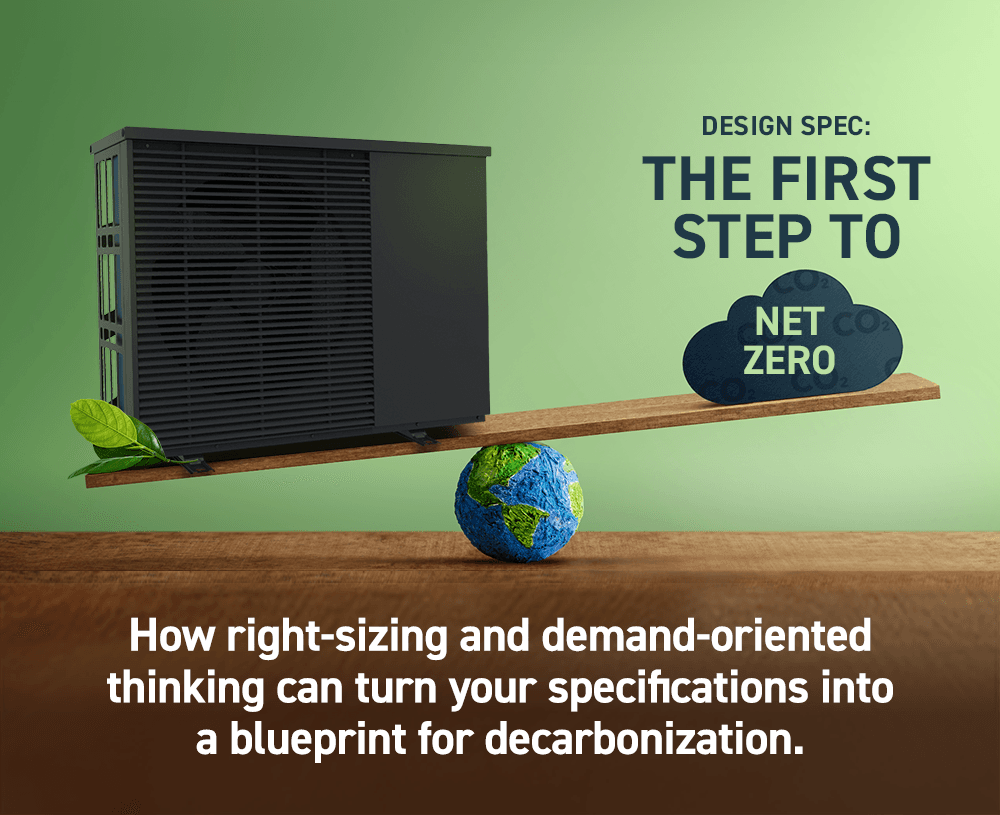
In a low-carbon economy, “performance” is being redefined. It’s no longer about installing the largest system possible. It’s about finding the sweet spot where capacity matches real demand with precision.
This demand-oriented design approach is gaining traction for good reason:
- Granular load analysis replaces one-size-fits-all assumptions, using advanced modelling to understand precisely how and when capacity is needed.
- Modularity allows systems to scale up or down based on actual demand, avoiding waste during off-peak periods
- Renewable integration is considered from day one, ensuring compatibility with solar PV, thermal storage, or waste heat recovery without costly retrofits later.
The philosophy is simple: design “as much as necessary, as little as possible.”
Thinking Beyond the Switch-On
Operational efficiency is critical, but it’s only part of the carbon story. A truly decarbonized design also considers what happens before and after a system’s active life.
That means looking at:
- Material selection: choosing components with lower embodied carbon.
- Manufacturing location: minimising transport-related emissions by producing closer to the point of installation.
- Circularity: designing for disassembly, recycling, and refurbishment so today’s assets don’t become tomorrow’s waste.
This lifecycle view transforms the design spec from a performance document into a sustainability strategy.
Regulation: The New Design Partner
Around the world, the policy environment is tightening. Flow temperature limits, refrigerant phase-downs, emission caps, and electrification mandates are becoming the norm.
Rather than treating these as obstacles, leading organizations are using regulation as a design accelerator:
Specifying low-GWP refrigerants ahead of mandates.
Building in hybrid flexibility for regions with grid constraints.
Ensuring digital readiness for integration with energy management systems.
By anticipating the rules of tomorrow, they create systems that stay competitive for decades.
A Shift Happening in Industry
In industrial environments, high-temperature heat pumps are quietly rewriting the rulebook. Capable of delivering process heat up to 200°C, they’re replacing fossil fuel boilers in sectors from food processing to chemicals.
When these systems are right-sized and designed for modularity, they not only slash emissions but also adapt seamlessly to fluctuating production demands. The payoff is twofold: operational savings and a stronger competitive position.
The Design Spec as Competitive Advantage
For procurement heads, product developers, and supply chain leaders, the design specification is no longer a formality. It’s a lever for transformation.
Get it right, and you:
Lower total cost of ownership.
Reduce both regulatory and reputational risks.
- Extend asset lifespan and adaptability.
- Position your business at the front of the low-carbon economy.
A Blueprint for Progress
Across the value chain, leaders are reimagining what goes into their design specs, and the results speak for themselves:
R&D teams are investing in advanced simulation tools and life cycle assessments to balance performance, cost, and sustainability from the earliest stages.
Procurement networks are being reshaped to prioritise suppliers with strong sustainability credentials, local manufacturing capabilities, and transparent material sourcing.
Supply chain planners are embedding modular refurbishment and end-of-life strategies to reduce waste and retain value.
Executive leadership is setting measurable decarbonization targets at the concept stage, creating alignment and accountability across departments.
These aren’t idealistic “nice-to-haves.” They are fast becoming the baseline for any organization seeking to remain competitive in a decarbonizing marketplace.Think of a design spec as an architectural drawing for carbon. Every number, every material choice, every assumption about demand becomes part of a chain reaction:
In the end, the design specification is more than a set of instructions. It’s a declaration of intent. It tells the market, the regulators, and the planet what kind of future you’re building for.
Decarbonization doesn’t begin at the end of the production line.
It begins with your first line, in your design spec.